
4K vs 2K dash cam: which resolution actually gives you better evidence on the road? At first glance, the answer seems obvious: more pixels should mean a better recording. In practice, resolution is only one part of image quality.
A useful dash cam also needs a good sensor, sharp optics, sufficient bitrate, effective HDR, sensible image processing and correct installation. A well-designed 2K model can therefore produce more useful footage than a poor camera advertised as 4K. A high-quality 4K dash cam, however, has a real advantage when you need to crop the image and identify a licence plate, road sign or small detail farther from the vehicle.
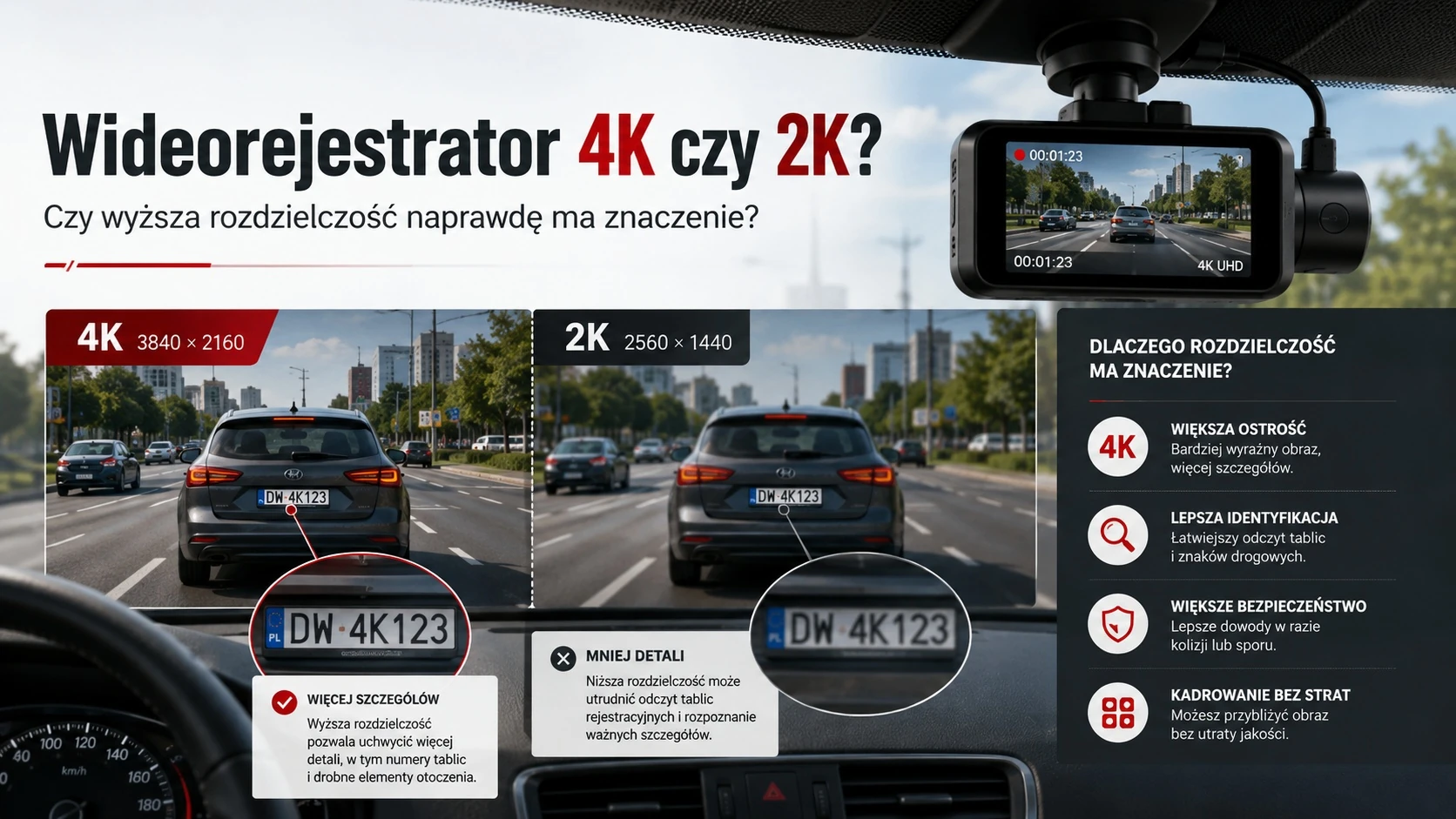
What do 4K and 2K mean in a dash cam?
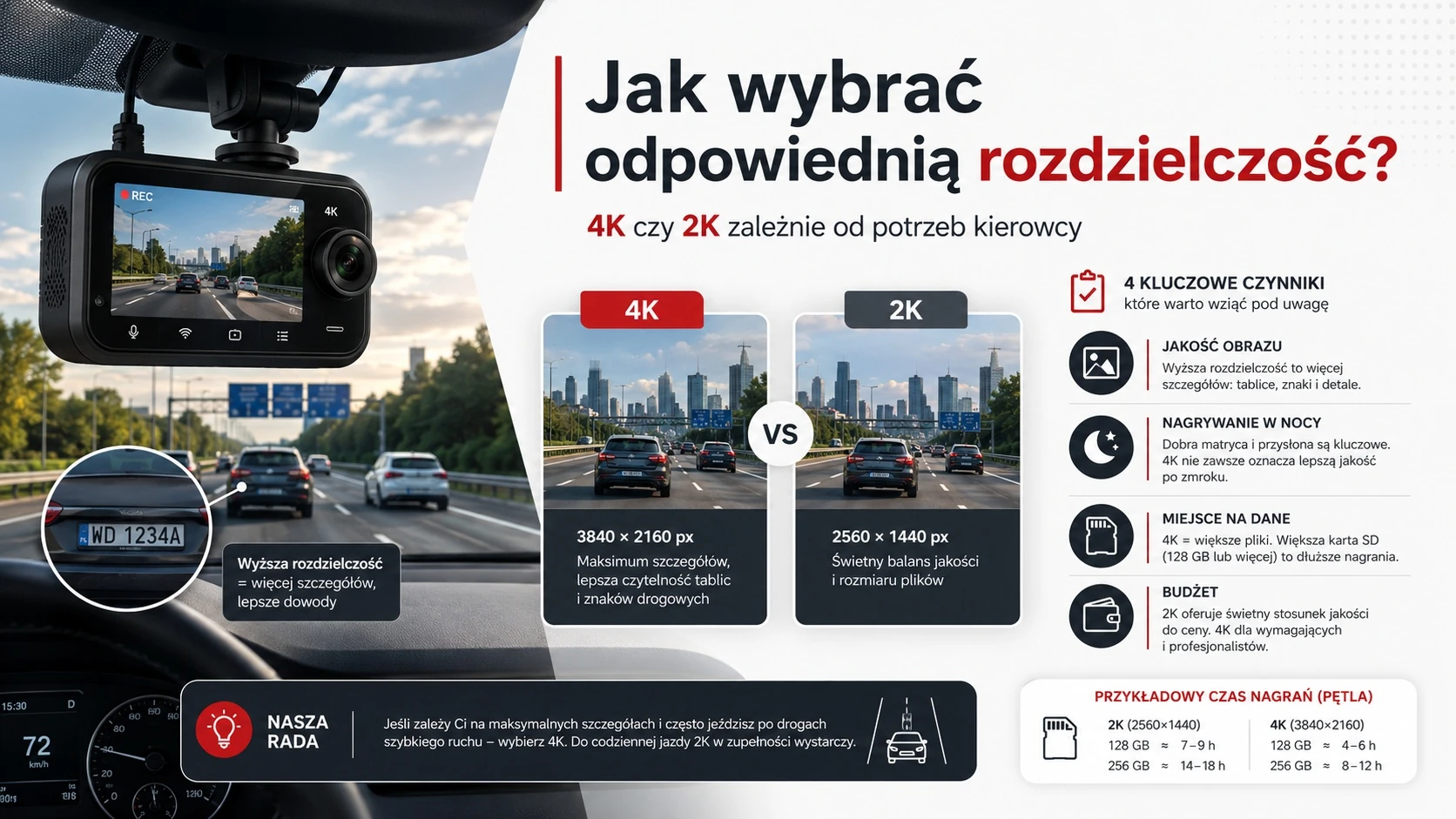
In car cameras, 4K usually means 3840 × 2160 pixels. Models described as 2K commonly record at 2560 × 1440 pixels.
A 4K frame contains significantly more image data. That extra information matters most when you review footage after an incident and enlarge only a small part of the frame. You may need to identify:
- a licence plate several metres away,
- a road sign at the edge of the picture,
- traffic lights farther down the road,
- a person outside the centre of the frame,
- details of another vehicle involved in an incident.
This ability to crop and zoom is where a genuinely good 4K recording has the clearest advantage.
Does 4K always mean better video quality?
No. Resolution tells you how many pixels are recorded, but not how useful those pixels will be.
Imagine one 4K camera with a small sensor, weak optics and aggressive compression. Compare it with a 2K model using a better sensor, sharper lens and more effective image processing. In difficult light, the 2K camera may preserve more readable detail.
This is why the large “4K” label on a box should never be the only reason to buy a dash cam.
What affects dash cam image quality besides resolution?
1. Image sensor
The sensor captures light. Its quality becomes especially important at night, in tunnels, during rain and in other low-light conditions. A good sensor can reduce noise, preserve information in shadows and control bright headlights or reflective licence plates.
2. Lens quality
Even an excellent sensor cannot deliver its full potential through a poor lens. Look for consistent sharpness across the frame, not only in the centre, and good performance in difficult lighting.
3. Bitrate
Bitrate is the amount of data used to save the recording over time. If compression is too aggressive, fine detail disappears even when the file is technically 4K.
4. HDR or WDR
High dynamic range processing helps when very bright and very dark areas appear in one frame. A common example is a car ahead at night: its plate may be strongly illuminated by your headlights while the rest of the vehicle remains in shadow.
5. Image processing
The camera software controls noise reduction, sharpening, exposure, white balance and compression. Two devices using similar hardware can therefore create noticeably different recordings.
Which is better for reading licence plates: 4K or 2K?
Licence plate identification is one of the strongest arguments for higher resolution. When another vehicle is close and travelling at a similar speed, a good 2K dash cam may be sufficient. The task becomes harder when the distance increases, the vehicles move relative to one another, or the plate is away from the centre of the frame.
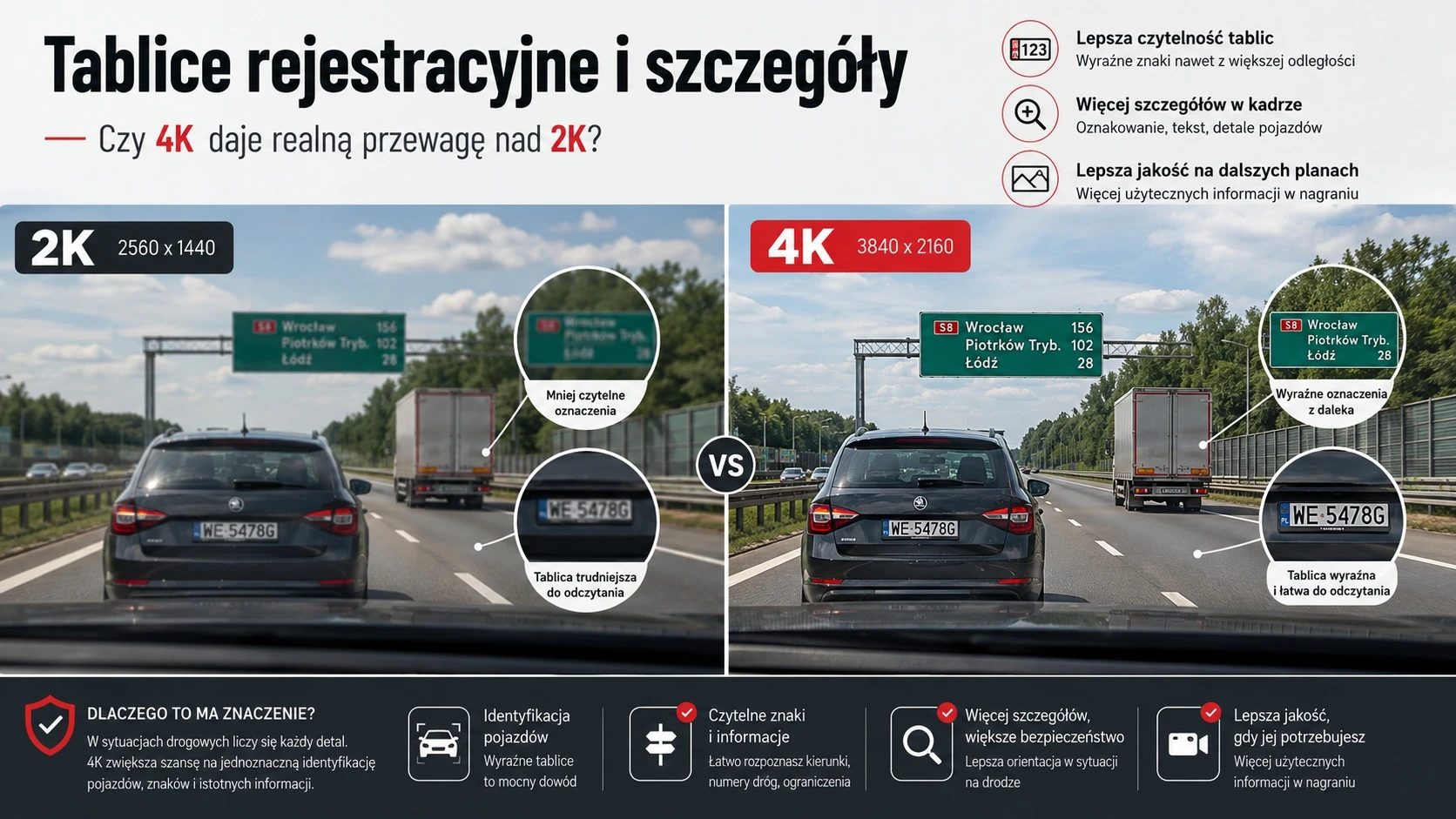
The additional pixels in a 4K image give you more freedom to crop and enlarge the footage later. Nevertheless, no camera can read every plate in every situation. Results also depend on:
- the speed of both vehicles,
- exposure time,
- available light, rain or fog,
- the angle of the other vehicle,
- reflections from the plate,
- the overall quality of the dash cam.
4K vs 2K dash cam at night
Night footage changes the comparison. A higher pixel count does not automatically produce a better result. The sensor, lens, HDR and image processing must cope with dark streets, bright headlights, street lamps and reflective signs at the same time.
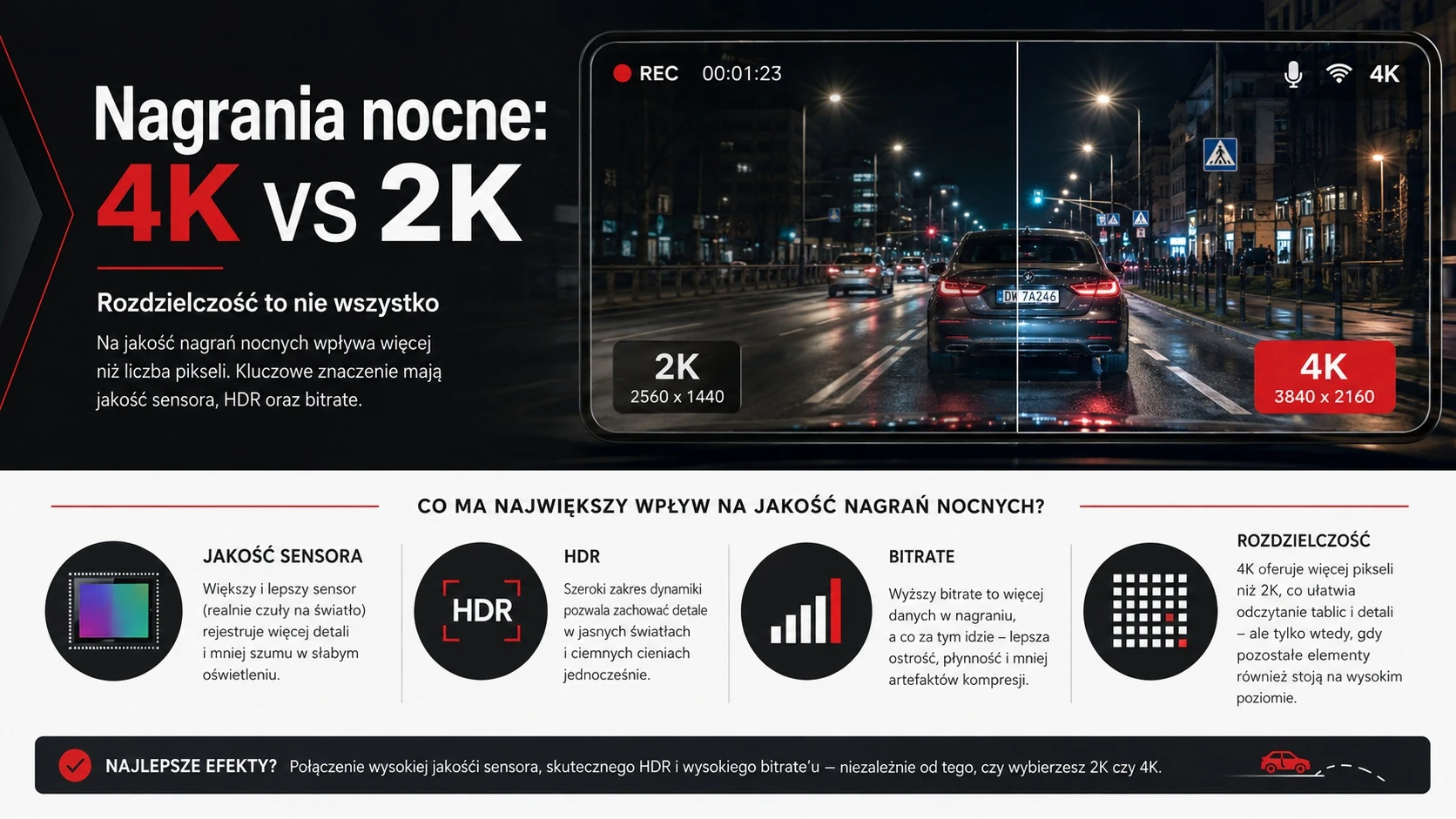
A high-quality 2K model can therefore outperform a cheap 4K device after dark. If you often drive at night, compare real recordings from the exact model rather than relying on resolution alone.
Does 4K use much more memory card space?
Usually yes, because more detail requires more data. The actual file size also depends on bitrate, codec, frame rate, the number of cameras and the device settings. There is no universal rule stating that one minute of 4K footage must always occupy a fixed amount of space.
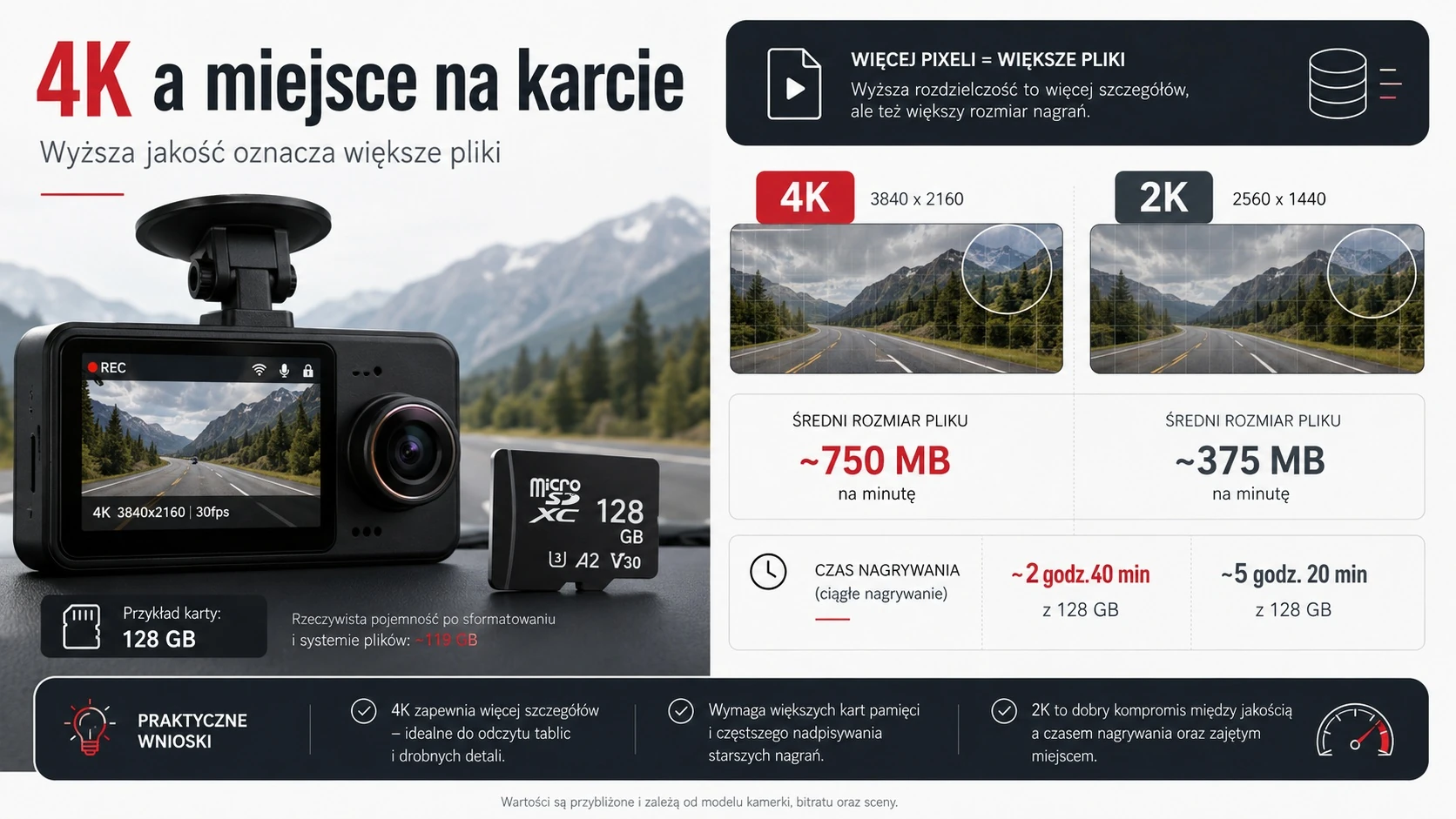
Choosing 4K may mean:
- using a larger high-endurance memory card,
- keeping a shorter recording history before files are overwritten,
- transferring more data to a phone,
- waiting longer when copying recordings.
The card capacity should be selected for the resolution, the number of channels and the amount of parking-mode use.
2K can be an excellent choice for everyday driving
Not every driver needs the maximum resolution. A good 2K dash cam can provide very useful footage when it has a strong sensor, you mainly drive in the city, you do not expect extreme digital zoom, and you prefer a longer recording history.
It can also make sense to spend the budget on a complete front-and-rear system or reliable parking mode instead of buying one average camera only because it carries a 4K badge.
When is a 4K dash cam worth choosing?
Consider 4K when:
- you often use motorways and high-speed roads,
- maximum detail is important,
- you want more freedom to enlarge footage after an event,
- vehicles farther away must remain identifiable,
- you are choosing a premium device with a good sensor and sufficient bitrate.
You can also see a practical example in our FineVu GX4K installation in a Toyota Corolla Hybrid, where the system includes a rear camera and parking protection.
When is 2K the more sensible choice?
2K is a strong compromise when you want good quality without the largest files, prefer a dual-channel system, need a longer recording history, or have found a model with proven night performance and a high-quality sensor.
Check the front and rear camera resolution
When comparing systems, do not look only at the front camera. Many kits use a lower resolution at the rear, even though important incidents may happen behind the vehicle or while it is parked. Compare the complete system, not only the largest number in the front-camera specification.
4K and parking mode
Higher resolution can also help while the car is parked, because the important evidence may be a small part of the frame: a passing vehicle’s plate or a person near the car. Parking monitoring also puts additional demands on power management and the memory card.
Our guide explains in more detail how parking mode works in a dash cam.
Why professional installation matters
Even an excellent camera can record poor footage if it is mounted in the wrong position. Common problems include excessive dashboard reflections, too much bonnet or headliner in the frame, sensors or heating elements blocking the view, incorrect rear-camera cable routing and parking mode that has not been configured properly.
With professional dash cam installation, the camera position, hidden wiring and power supply can be matched to the specific vehicle. This allows the complete system—not only its headline resolution—to work as intended.
How to choose the right dash cam resolution
Ask yourself:
- Do I need the best possible chance of reading small details?
- Do I often drive on fast roads?
- Is a long recording history more important than maximum resolution?
- Do I also need a good rear camera?
- Will the dash cam operate in parking mode?
- How does this exact model perform at night?
If maximum detail is the priority and you are buying a high-quality system, 4K makes sense. If you want a balanced everyday setup, a strong 2K camera may be completely sufficient.
Do not choose a dash cam based only on the 4K label
Resolution matters, but it is only one part of the system. Before buying, compare the sensor, real night footage, HDR, bitrate, rear-camera quality, supported memory cards, parking mode, app, recording transfer process and power supply.
You can find more available solutions in our dash cam section.
4K vs 2K dash cam: summary
4K records more detail and gives you more freedom to crop the image. This can be valuable when identifying licence plates, signs and objects farther from the camera.
It does not mean that every 4K model is better than every 2K device. At night and in difficult conditions, the sensor, lens, bitrate, HDR and processing are just as important. The best approach is to choose the complete system for the way you use your car and then install and configure it correctly.
Frequently asked questions
Does a 4K dash cam really record better video than 2K?
When sensor, lens and processing quality are comparable, 4K captures more detail and allows stronger cropping. A poor 4K camera can still perform worse than a high-quality 2K model.
Is 4K better for reading licence plates?
Higher resolution can improve the chance of reading a plate, especially when it is farther away. The result still depends on speed, light, exposure and the quality of the camera.
Is 4K better at night?
Not always. Sensor quality, lens aperture, HDR and image processing have a major influence after dark. A good 2K model may outperform a weak 4K device.
Do 4K recordings fill a memory card faster?
Usually yes, although actual file size depends on bitrate, codec and the device settings.
Is 2K enough for everyday driving?
A high-quality 2K dash cam can be an excellent everyday solution. The overall device quality matters more than the resolution number alone.


