Noise inside a moving vehicle rarely comes from just one location. The cabin is exposed to tyre and road noise, airflow around the body, engine and drivetrain sounds, exhaust noise and vibrations travelling through large metal panels. Door cards, dashboard components, trim panels and the luggage compartment can create additional rattles and resonances.
Effective car soundproofing should therefore begin with identifying the dominant source of noise. Different solutions are required for tyre roar, vibrating doors, engine noise or low-frequency sound transmitted through the floor and firewall. You can learn more about available solutions on our page dedicated to professional car soundproofing and vehicle damping.
The main sources of noise inside a car
The acoustic comfort of a vehicle depends on its body construction, tyre type, door seals, driving speed and the amount of factory sound insulation. The same vehicle may seem relatively quiet in urban traffic but become noticeably louder on an expressway or motorway.
The most common sources of unwanted noise include:
- tyres and road surfaces,
- airflow around the vehicle body,
- the engine, transmission and exhaust system,
- vibrations of the floor, wheel arches and body panels,
- resonance from doors, trim panels, dashboard components and the trunk.
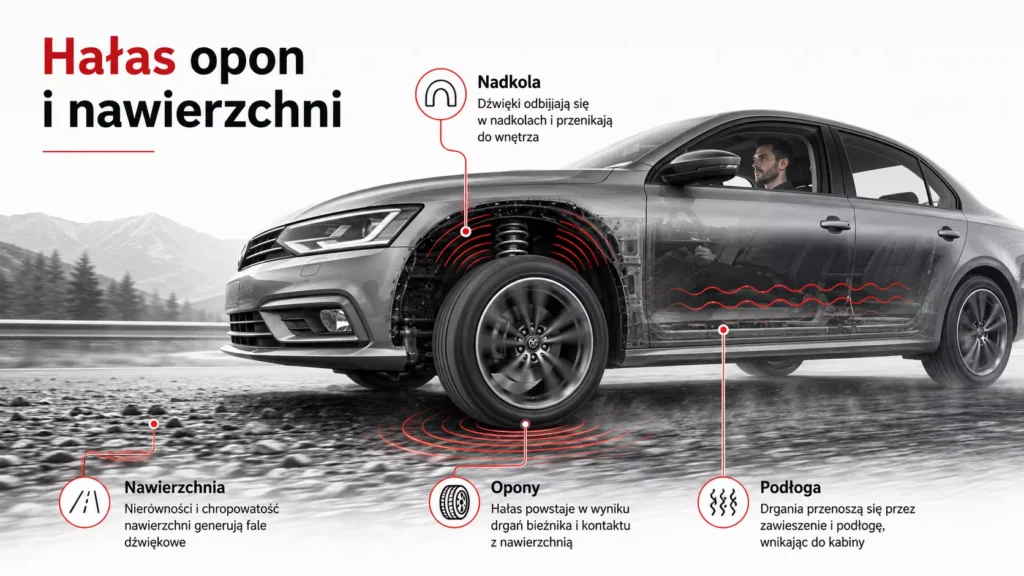



Tyre and road surface noise
One of the most noticeable noise sources is the contact between the tyres and the road. As the tyre rotates, its tread repeatedly hits the surface. The resulting vibrations travel through the wheel, suspension, wheel arches and floor before reaching the passenger compartment.
The rougher or more damaged the road is, the more noticeable the characteristic tyre roar or low-frequency rumble becomes. Noise levels also depend on tyre width, tread pattern, profile, pressure and wear. Winter tyres and aggressive tread patterns can be noticeably louder than tyres designed primarily for comfort.
Road noise commonly enters the cabin through:
- the front and rear wheel arches,
- the cabin floor,
- the trunk floor and side panels,
- suspension mounting points,
- the area underneath the rear seats.
In this case, effective car noise insulation usually requires a vibration-damping layer combined with sound-absorbing and insulating materials. A small piece of thin damping mat may not be enough to control low-frequency tyre and road noise.
Wind noise at higher speeds
As speed increases, airflow around the vehicle becomes increasingly important. Air passes over the bumper, bonnet, windshield, A-pillars, mirrors and roofline. Turbulence created around these areas can be heard inside the cabin as a constant rush, hiss or whistle.
Wind noise is most commonly noticeable around:
- side mirrors,
- A-pillars,
- upper window edges,
- door seals,
- roof rails and other exterior accessories.
When a whistle appears suddenly, the condition of the seals, doors, windows and exterior body components should be checked first. Soundproofing cannot replace the repair of a damaged or leaking seal. It can, however, reduce the amount of general airflow noise transmitted through doors, the roof and interior trim.
Engine, transmission and exhaust noise
The engine generates both sound and vibration. These travel through engine mounts, the engine bay, firewall, transmission tunnel and vehicle floor. Their intensity and character depend on the engine design, number of cylinders, engine speed, exhaust system and factory insulation.
Diesel engines often generate more noticeable low-frequency vibration, while petrol engines may become considerably louder at higher revolutions. In hybrid and electric vehicles, reduced powertrain noise can make tyre and wind noise easier to notice.
Powertrain sounds may enter the cabin through:
- the firewall between the engine and cabin,
- areas around the pedals and steering column,
- the transmission tunnel,
- the vehicle floor,
- the luggage compartment above the exhaust system.
Before applying acoustic materials, mechanical problems should be ruled out. Worn engine mounts, loose heat shields, exhaust leaks and damaged suspension components can all cause abnormal sounds. Sound insulation is intended to reduce normal noise and vibration, not hide a mechanical fault.
Door resonance and large body panels
Doors, the roof, floor, tailgate and side body panels have relatively large surfaces. When excited by road vibration, engine movement or loudspeakers, these panels can behave like membranes and amplify certain frequencies.
Typical symptoms include:
- metallic booming at a particular road speed,
- door card vibration while listening to music,
- plastic trim rattles on uneven roads,
- tailgate and luggage compartment resonance,
- a thin metallic sound when closing the doors.
Correctly installed door damping reduces outer skin resonance and creates more stable operating conditions for the loudspeakers. Additional information about materials, layering and priority areas is available in our car soundproofing guide.
Noise generated by interior trim
Not every unwanted sound comes from outside the vehicle. Some noises originate inside the cabin. Plastic parts may rub against each other, wiring can strike trim panels and damaged clips may rattle when driving over uneven roads.
Common problem areas include:
- door cards,
- the dashboard and centre console,
- pillars and the headliner,
- trunk side panels,
- the number plate and tailgate trim,
- wiring located behind interior panels.
Soft separation materials, acoustic foam and anti-rattle tapes are often used in these locations. Accurate diagnosis remains essential. Adding more layers without locating the actual contact point can increase weight without solving the problem.
Why is factory sound insulation sometimes insufficient?
Vehicle manufacturers must balance comfort, vehicle weight, manufacturing cost and assembly time. In many popular models, factory acoustic materials cover only selected zones or use relatively thin layers.
Differences can even occur between versions of the same model. A vehicle equipped with wider tyres, larger wheels, a more powerful engine or different optional equipment may produce more noise despite having a similar amount of factory insulation.
Properly installed car soundproofing improves driving comfort by reducing road roar, body resonance and vibration. The final result always depends on the vehicle design, starting condition, selected materials and the scope of work.
How does professional vehicle damping work?
Professional vehicle damping and sound insulation do not rely on one universal material applied throughout the car. Different layers perform different functions:
- Vibration-damping material controls sheet-metal movement and resonance.
- Sound-absorbing material reduces reflections inside doors and cavities.
- Noise barrier material creates an additional obstacle for sound entering the cabin.
- Anti-rattle materials reduce friction and contact between interior trim components.
Materials must be selected according to temperature, moisture exposure, available space and the movement of the treated component. A layer that is too thick may prevent the original trim from being reinstalled correctly, while unsuitable materials may absorb moisture or become detached over time.
Which areas should be soundproofed first?
The scope of work should match the type of noise:
- Loud tyre roar: wheel arches, floor and trunk.
- Noise entering from the sides: doors and side body panels.
- Engine noise: firewall, front floor section and transmission tunnel.
- Noise around the roof: roof treatment, pillars and inspection of door seals.
- Car audio resonance: doors, door cards, trunk and loudspeaker mounting locations.
It is not always necessary to dismantle the entire interior. In some vehicles, treating the doors and wheel arches provides a very good improvement for the available budget. In others, the floor or trunk remains the dominant noise path.
Does car soundproofing improve audio quality?
Reducing the background noise floor allows music to remain clearer without constantly increasing the volume. Damped and reinforced doors also provide better working conditions for midbass loudspeakers.
Soundproofing does not replace quality loudspeakers, an amplifier or correct DSP tuning, but it creates a strong foundation for the whole installation. Our car audio service guide explains how acoustic preparation works together with loudspeakers, amplification and system tuning.
How can you identify the dominant source of noise?
Before choosing a treatment package, pay attention to when the noise becomes most noticeable:
- if it increases with vehicle speed regardless of engine revolutions, the source may be the tyres, road surface or airflow,
- if it changes with engine speed, the powertrain, firewall and exhaust system should be checked,
- if it appears mainly on a particular type of asphalt, tyre and road noise is probably dominant,
- if it occurs at specific music frequencies, the doors or interior trim may be resonating,
- if individual rattles appear on bumps, a loose interior component may need to be located.
Professional car soundproofing at Sound Audio System
At Sound Audio System, the treatment scope is selected according to the vehicle design, the owner's expectations and the dominant sources of noise. We can treat the doors, floor, wheel arches, roof, trunk, tailgate, bonnet and other areas requiring improved acoustic insulation.
Before starting the installation, we determine whether the main goal is reducing motorway noise, improving car audio performance, eliminating trim resonance or carrying out comprehensive cabin soundproofing.
Use our car soundproofing quotation configurator to check the available areas and estimate the scope of work.
Frequently asked questions
Can all noise be completely removed from a car?
No vehicle cabin can be completely isolated from every sound. Professional treatment can, however, noticeably reduce the most tiring road noise, vibration and resonance. The final improvement depends on the vehicle construction and treatment scope.
Is door soundproofing enough?
Door treatment can improve cabin acoustics and reduce some noise entering from the sides. It will not remove tyre and road noise transmitted through the floor, wheel arches or luggage compartment.
Does a thicker mat always provide better results?
No. The material must match the surface and the type of noise being treated. Thickness is only one factor. Weight, flexibility, temperature resistance, moisture resistance and the correct combination of layers are equally important.
Does car soundproofing increase vehicle weight?
Yes. Acoustic materials add weight to the vehicle. The scope and material selection should therefore be planned carefully to achieve a worthwhile improvement without unnecessary loading.
When is the best time to soundproof a car?
Soundproofing can be installed at any stage of vehicle ownership. It is particularly useful during a car audio upgrade, interior repair or whenever road noise begins to reduce comfort and increase fatigue on longer journeys.
```