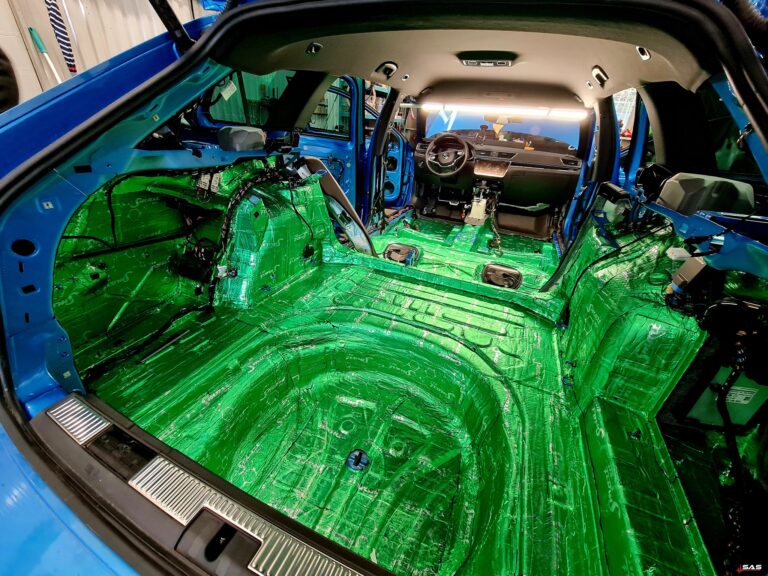
Tyre noise is one of the most noticeable sound sources while driving. It may be barely audible on smooth asphalt and then become dominant inside the cabin as soon as the vehicle reaches a coarse road surface. Its intensity depends not only on the tyres but also on speed, road texture, wheel arch construction, floor panels and the vehicle’s factory sound insulation.
Answering the question why tyre noise is so loud inside a car therefore requires looking at the complete system: the tyre, road surface, suspension and vehicle body. Noise generated where the tread meets the road is transmitted through the wheel arches, floor, luggage compartment and structural panels into the cabin.
For a broader explanation of vehicle noise, begin with our guide describing where car noise comes from. This article focuses specifically on tyre roar, rolling noise and practical ways to reduce it.
Where does tyre noise come from?
The tyre tread does not move across the road in a completely smooth way. Every section of the tread enters the contact patch, deforms under the weight of the vehicle and then separates from the surface. This creates vibration and changes in air pressure inside the tread grooves.
Rolling noise consists of several processes occurring at the same time:
- tread blocks striking the road surface,
- rubber deformation inside the contact patch,
- air being compressed and released from tread grooves,
- sidewall vibration,
- vibration transmitted through the wheel, hub and suspension,
- sound reflecting inside the wheel arch,
- resonance of the floor, trunk and large body panels.
The driver therefore hears a combination of sound rather than one simple noise. It may be perceived as a constant rush, low-frequency rumble or booming that changes with speed and road texture.



Why does the road surface change tyre noise so much?
The road surface is one of the most important factors affecting tyre noise. On smooth asphalt, the tread moves more consistently and produces fewer sudden impacts and micro-vibrations. On a coarse surface, road irregularities excite the tyre, suspension and metal body panels more intensely.
The same car and tyre set may therefore be:
- relatively quiet on new and smooth asphalt,
- considerably louder on coarse road surfaces,
- even more noticeable on wet or damaged roads.
When noise changes almost immediately after entering a different type of asphalt, tyre and road noise are probably dominant. Engine or exhaust noise would not normally react so directly to road texture.
Why can a wet road be louder?
On a wet surface, the tread must also move water away from the contact patch. Flowing water creates additional noise, while impacts against wheel arch liners and underbody covers add further sound.
Wet-road driving may produce:
- stronger noise underneath the wheels,
- water impacts against plastic wheel arch liners,
- spray noise underneath the floor,
- more noticeable booming from the rear of the vehicle.
These conditions often reveal how effective the factory insulation of the wheel arches, floor and trunk really is.
How does tread design affect tyre noise?
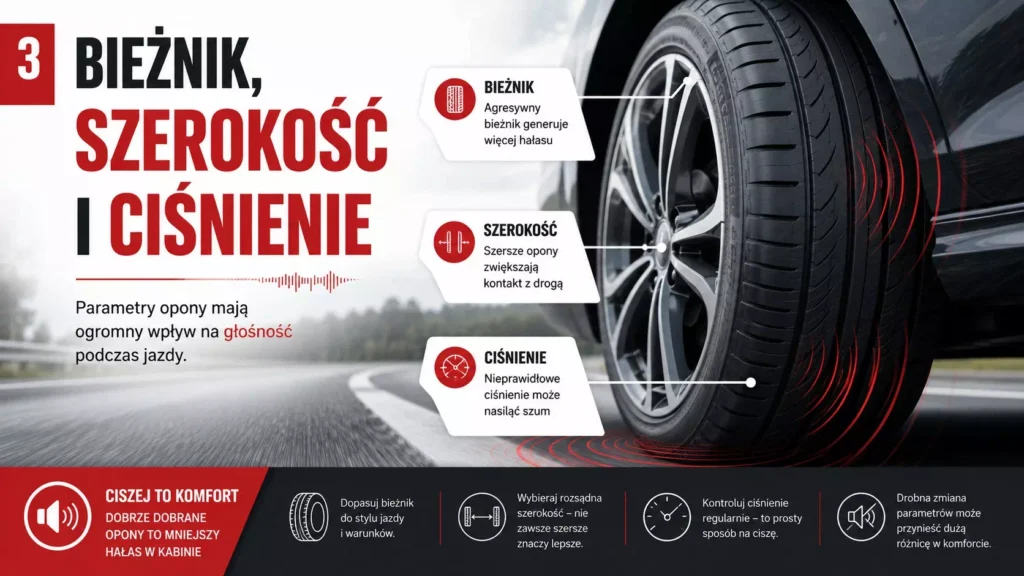
The shape, number and arrangement of tread blocks influence how the tyre contacts the road. Large and aggressive tread elements can generate more noticeable noise than a finer tread designed primarily for comfort.
Potentially louder tyres include:
- off-road tyres,
- models with aggressive tread patterns,
- some winter tyres,
- unevenly worn tyres,
- tyres with tread cupping.
This does not mean that every winter or performance tyre must be loud. The complete construction, rubber compound, groove arrangement and tread block distribution all influence the final result.
Are wider tyres always louder?
A wider tyre usually has a larger contact area with the road and may excite a greater surface, producing more rolling noise. The final result also depends on tread design, compound, profile and the construction of the specific model.
Two tyres of the same width may therefore have very different noise characteristics. A well-designed wider tyre can also be quieter than a narrower model with an aggressive or unevenly worn tread.
When choosing tyres, consider:
- the declared external noise rating,
- user feedback about interior comfort,
- tread design,
- the intended purpose of the tyre,
- compatibility with the weight and characteristics of the vehicle.
Tyre profile and wheel size
A lower-profile tyre has a stiffer sidewall and less rubber between the wheel rim and the road. It can transmit vibration into the suspension and body more directly than a tyre with a taller sidewall.
Large wheels and low-profile tyres may improve steering response but can also:
- reduce the tyre’s ability to absorb road irregularities,
- make vibration more noticeable,
- transmit noise more directly into the body structure.
This is not an absolute rule. A well-designed suspension system and effective factory sound insulation can compensate for part of this effect.
Tyre pressure and rolling noise
Incorrect pressure changes the way the tread contacts the road. Both underinflation and overinflation can reduce comfort, accelerate wear and change the sound generated by the tyre.
Incorrect tyre pressure may cause:
- uneven tread contact,
- excessive sidewall deformation,
- greater vibration transmission,
- accelerated or uneven wear,
- additional low-frequency rumble.
Tyre pressure should be checked when the tyres are cold and set according to the vehicle manufacturer’s recommendations and current load.
Uneven wear and tread cupping
When a tyre wears unevenly, consecutive tread sections may strike the surface with different intensity. This can create a characteristic rumble that often becomes louder with speed.
Possible causes include:
- incorrect wheel alignment,
- worn shock absorbers,
- suspension play,
- incorrect tyre pressure,
- lack of tyre rotation between axles,
- damage to the tyre itself.
Vehicle soundproofing may reduce part of the noise reaching the cabin, but it cannot replace repairing the suspension or replacing damaged tyres.
Can a very loud wheel indicate a mechanical fault?
Not every sound that increases with road speed comes directly from the tyre tread. Similar symptoms may be caused by wheel bearings, suspension components, underbody covers or tyre damage.
Mechanical inspection is particularly important when:
- the noise appeared suddenly,
- it is much stronger on one side,
- it changes while cornering,
- the steering wheel vibrates,
- the car pulls to one side,
- the tyre has visible bulges or uneven wear.
Mechanical faults should always be ruled out before acoustic treatment begins.
How does tyre noise enter the cabin?
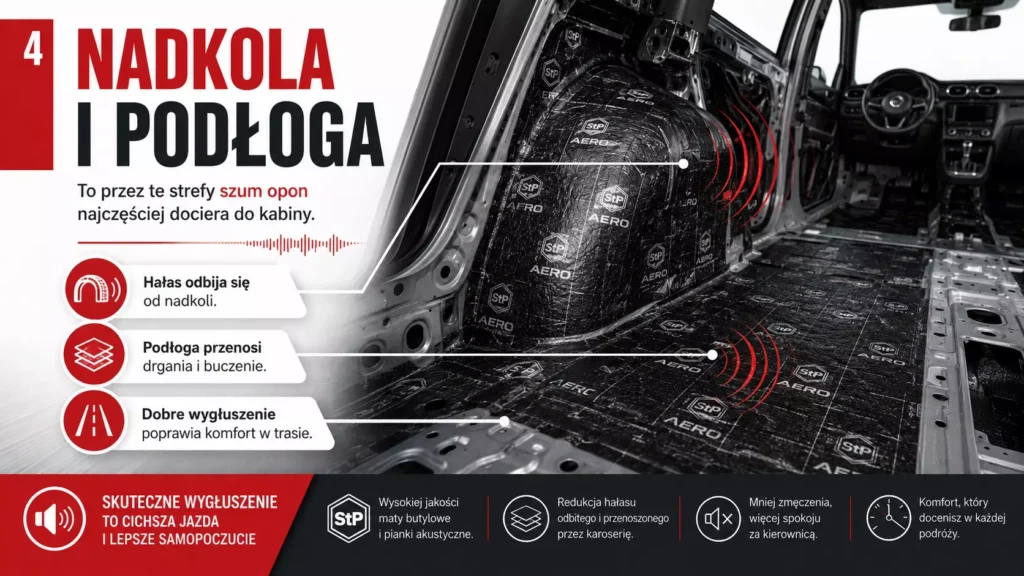
Noise does not enter only through the air. A large amount of energy is structurally transmitted through the wheel, suspension and metal vehicle body.
The most important noise paths include:
- front and rear wheel arches,
- the cabin floor,
- the trunk floor and side panels,
- suspension mounting points,
- the area underneath the rear bench,
- sills and side body sections.
In estates, hatchbacks, SUVs and vans, the rear wheel arches and luggage compartment may have a particularly strong influence because they are not separated from the passenger compartment by a rigid partition.
Why do wheel arches amplify tyre noise?
The wheel arch is positioned directly above the rotating tyre. Sound created at the tyre-road contact point reflects from metal and plastic surfaces before exciting the body panels.
With limited factory insulation, the wheel arch can amplify:
- tyre roar,
- water impacts,
- stone and gravel noise,
- low-frequency booming transmitted into the trunk.
Professional wheel arch soundproofing should take into account the construction of the vehicle, access from inside the cabin and the design of the exterior wheel arch liners.
The role of the floor and luggage compartment
The floor has a large surface and is connected with the sills, transmission tunnel and suspension mounting points. It can transmit road noise throughout the whole cabin, particularly at higher speeds.
The luggage compartment includes the rear wheel arches, spare wheel well, side cavities and tailgate. In many vehicles, it forms a large resonating chamber that amplifies noise from the rear axle.
Our guide explaining what to soundproof first in a car can help you choose the correct treatment order.
How can tyre noise be reduced?
An effective solution begins with determining whether the main cause is the tyre itself, a mechanical fault or insufficient acoustic insulation.
1. Inspect the tyres
Check tread depth, wear pattern, age, possible cupping and damage to the sidewall.
2. Check tyre pressure
Pressure should follow the vehicle manufacturer’s recommendations and current vehicle load.
3. Inspect alignment and suspension
Incorrect wheel alignment and worn suspension parts can cause uneven wear and additional noise.
4. Choose quieter tyres
During the next tyre replacement, consider acoustic comfort, tread design and the intended purpose of the selected model.
5. Soundproof the wheel arches, floor and trunk
When the tyres and suspension are in good condition but noise still enters the cabin, correct vehicle damping can reduce sound transmission through the body.
How do wheel arch and floor treatments work?
Professional car soundproofing uses several types of materials because each layer performs a different function.
- Vibration-damping material controls metal panel movement and resonance.
- Sound-absorbing material reduces reflections inside cavities.
- Noise barrier material limits sound passing into the cabin.
- Anti-rattle materials reduce trim vibration and contact noise.
Applying one small piece of damping mat in the centre of a wheel arch may not be enough. Effective treatment depends on coverage, surface preparation, correct layering and accurate reassembly of the interior.
Can soundproofing completely eliminate tyre noise?
No cabin can be completely isolated from the sound produced during driving. Soundproofing also does not change the tyre itself or the road surface.
It can, however:
- reduce wheel arch and floor vibration,
- lower the intensity of noise entering the cabin,
- control low-frequency booming from the rear,
- improve conversation and music clarity,
- reduce fatigue during longer journeys.
The best result comes from combining correctly selected and maintained tyres with properly installed vehicle soundproofing.
Tyre noise during motorway driving
As speed increases, tyre roar becomes more intense and combines with airflow noise and body vibration. A car that seems quiet in the city may therefore become noticeably louder during longer journeys.
More information about selecting treatment areas for higher-speed driving is available in our guide to car soundproofing for motorway driving.
Car soundproofing and driving comfort
Reducing tyre noise is not only about obtaining a lower sound level. Less rumble and road roar can improve conversation, allow music to remain clear at a lower volume and reduce fatigue on long journeys.
The treatment scope may include:
- front and rear wheel arches,
- the cabin floor,
- the area underneath the rear bench,
- the trunk floor and side panels,
- the tailgate,
- additional components responsible for resonance.
Professional car soundproofing and vehicle damping should match the construction of the vehicle, tyre type and the area from which the noise is most noticeable.
Common mistakes when trying to reduce tyre noise
- Soundproofing the car without inspecting the tyres.
- Trying to hide a worn wheel bearing or suspension fault.
- Using one material for every acoustic layer.
- Applying random damping patches without consistent coverage.
- Ignoring the rear wheel arches and trunk in an estate or SUV.
- Assuming that a wider or more expensive tyre must be quieter.
- Ignoring incorrect pressure and wheel alignment.
Why is tyre noise so loud? Summary
Tyre noise begins at the contact point between the tread and the road, but its perceived level depends on the complete vehicle. Road texture, tyre design, width, profile, pressure, suspension condition and factory insulation all influence acoustic comfort.
When the noise changes with the road surface, increases with speed and clearly comes from the wheel area, the main paths usually include the tyres, wheel arches, floor and luggage compartment. After mechanical and tyre-related problems have been ruled out, correctly selected soundproofing can noticeably reduce the amount of tyre roar entering the cabin.
Frequently asked questions
Why are some tyres louder than others?
Tyres differ in construction, compound, tread design, width and intended use. Wear condition and compatibility with the specific vehicle also influence noise levels.
Does tyre noise always mean that the tyres are worn?
No. It may be caused by coarse asphalt, tyre construction, wheel width or limited factory insulation. A sudden change in noise should still be inspected.
Does wheel arch soundproofing reduce tyre noise?
Yes. It can reduce metal panel vibration, sound reflections and the amount of noise entering the cabin. The result depends on vehicle construction and treatment scope.
Which is more effective: wheel arch or floor soundproofing?
It depends on the main noise path. When the sound comes directly from the wheel area, the wheel arches may be the priority. When noise is distributed under the entire cabin, the floor becomes more important.
Will changing to quieter tyres be enough?
It may provide a major improvement when the current tyres are the main source of the problem. When sound is additionally amplified by thin wheel arches, the floor and luggage compartment, improved vehicle insulation may also be required.