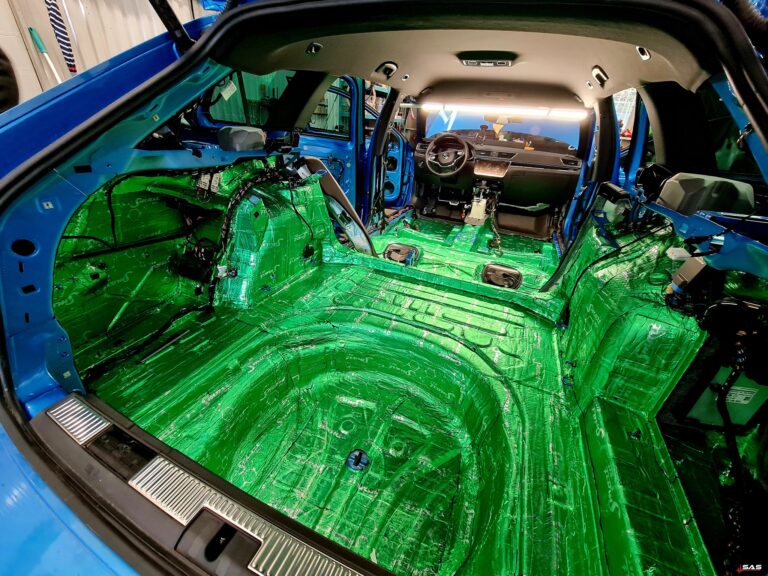
A car that seems reasonably quiet in urban traffic can become noticeably more tiring on a motorway. As speed increases, tyre roar, road noise, airflow and vibrations transmitted through the floor, wheel arches, doors and roof all become more noticeable.
Effective car soundproofing for motorway driving is not based on applying random damping patches in several locations. The dominant type of noise should be identified first, followed by selecting the correct areas and acoustic materials. Tyre roar, floor vibration and wind noise require different treatment strategies.
When the source is unclear, begin with our guide explaining where car noise comes from. Our article about what to soundproof first in a car can also help you choose the correct starting point.
Why does a car become louder on a motorway?
Several types of noise increase at the same time during faster driving. The tyre tread repeatedly strikes the road surface, airflow moves more quickly around the vehicle and suspension vibration reaches large metal body panels.
The most noticeable motorway noise sources include:
- tyre and rough road surface noise,
- sound transmitted through the front and rear wheel arches,
- vibration of the floor and transmission tunnel,
- booming from the trunk and rear body panels,
- airflow around mirrors, pillars and windows,
- resonance from doors, roof panels and interior trim,
- engine, transmission and exhaust noise.
One solution will therefore not be equally effective in every vehicle. The treatment scope should match the actual paths through which sound enters the cabin.
Car soundproofing for motorway driving – quick treatment guide
| Symptom during faster driving | Likely source | Areas to inspect or treat |
|---|---|---|
| Noise changes with the type of road surface | Tyres and road surface | Wheel arches, floor and trunk |
| Noise increases around windows and mirrors | Airflow or leaking seals | Doors, pillars, roof and seal inspection |
| Low-frequency rumble underneath the cabin | Floor, exhaust or drivetrain | Floor, transmission tunnel and firewall |
| Booming mainly comes from the rear | Rear wheel arches, trunk and tailgate | Trunk, rear wheel arches and tailgate |
| Wind and vibration are noticeable above the occupants | Roof panel and airflow | Roof, pillars and exterior accessories |



Tyre noise – a common problem during motorway driving
Tyre noise is created where the tread meets the road surface. Every section of the tyre deforms, strikes the asphalt and generates vibration. The sound then travels through the wheel, suspension, wheel arch, floor and vehicle body.
The level of tyre roar depends on factors including:
- the type and condition of the road surface,
- tyre width,
- sidewall profile,
- tread design and construction,
- tyre pressure,
- wear and uneven tread condition,
- factory insulation of the wheel arches and floor.
A vehicle may be quiet on smooth asphalt and considerably louder on a coarse surface. This normally indicates that the tyres and road surface are more important than the engine.
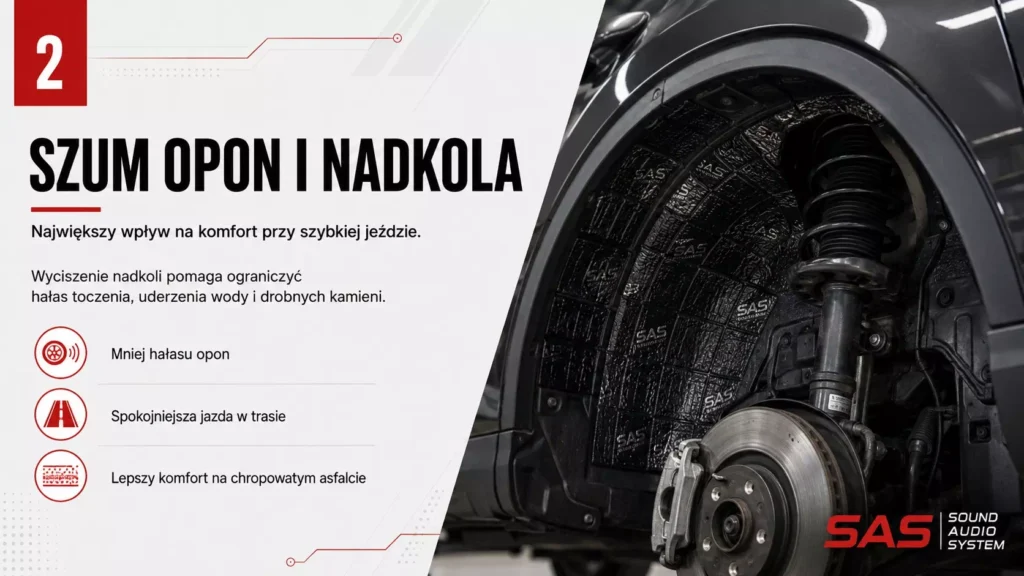
Wheel arch soundproofing for motorway use
The wheel arches are located directly beside the source of tyre and road noise. Sound reflects from metal and plastic surfaces before entering the cabin.
Professional wheel arch soundproofing may involve treatment from inside the vehicle, from the exterior wheel arch area or a combination of both approaches. The correct method depends on the vehicle construction and available access.
Wheel arch treatment can help reduce:
- tyre roar,
- noise from coarse road surfaces,
- water, mud and stone impacts,
- vibration of large metal panels,
- noise entering the trunk and rear cabin.
Rear wheel arches are particularly important in estates, SUVs, crossovers, vans and hatchbacks because the luggage compartment is directly connected with the passenger area.
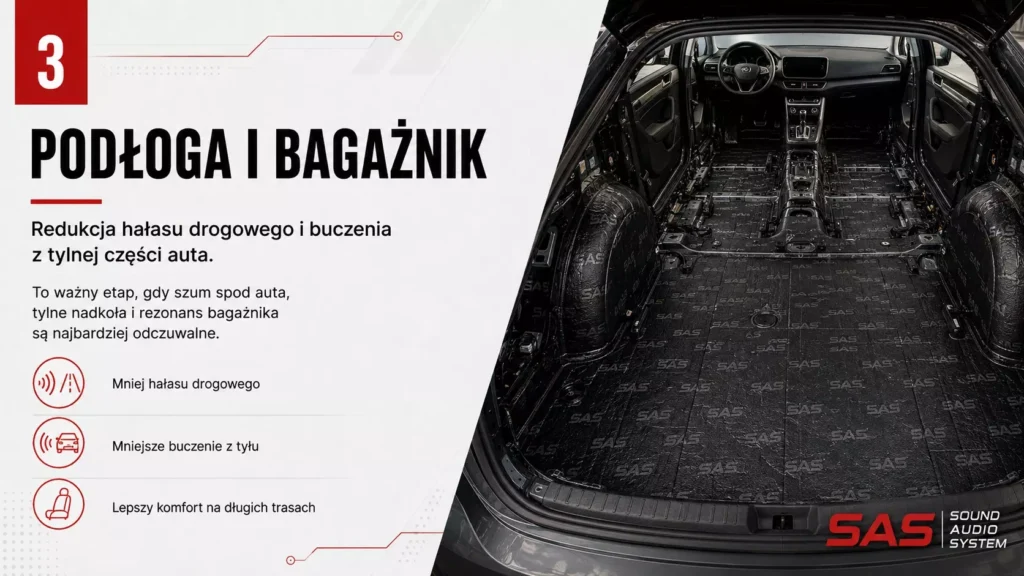
Floor soundproofing – reducing noise underneath the vehicle
The vehicle floor is connected with the sills, transmission tunnel, seat mounting points and suspension-related areas. It transmits tyre noise, underbody vibration, exhaust sound and part of the noise produced by the drivetrain.
Floor treatment is an extensive process because the seats, rear bench, sill trims, sections of the centre console and factory carpet normally need to be removed. It does, however, provide access to a large part of the lower cabin structure.
Floor soundproofing should be considered when:
- noise is distributed underneath the entire cabin,
- a low-frequency rumble occurs during faster driving,
- the sound is not limited to one wheel arch,
- exhaust noise enters the cabin,
- comprehensive vehicle soundproofing is planned.
Trunk and rear body soundproofing
The trunk can behave like a resonating chamber. It contains the rear wheel arches, a wide floor panel, spare wheel well, side cavities and tailgate. These areas can amplify tyre noise and body vibration.
Trunk treatment is particularly useful when:
- booming mainly comes from the rear,
- noise increases after folding the rear seats,
- rear tyre noise is clearly audible,
- the tailgate or its trim vibrates,
- a subwoofer is installed in the luggage compartment.
Treating the trunk floor, rear wheel arches and side cavities as one acoustic zone often provides a more complete result than placing material on one small panel.
Wind noise around the vehicle body
As speed increases, air moves more intensely around the vehicle. Turbulence is commonly created around mirrors, A-pillars, upper window edges, roof rails, trim strips and other exterior components.
Aerodynamic noise may be heard as:
- constant noise around the windows,
- a whistle from one specific location,
- noise around the mirrors,
- airflow heard above the occupants,
- vibration of seals or exterior components.
General wind noise should be distinguished from a whistle caused by a leak. Damaged seals, incorrectly adjusted doors or a window that does not close correctly require repair. Acoustic materials should not be used to hide these problems.
Door soundproofing for long-distance driving
Doors have large and relatively thin body panels. They can transmit airflow noise, sound from other vehicles and vibration of the body. They also contain loudspeakers that can create additional resonance.
Door treatment can:
- reduce inner and outer door skin resonance,
- limit part of the noise entering from the sides,
- stabilise interior door cards,
- improve operating conditions for the loudspeakers,
- provide tighter midbass and clearer sound.
Doors are not always the main priority when tyre roar is transmitted through the floor and wheel arches. In that situation, they should be treated as one part of a wider motorway noise reduction package.
Roof soundproofing – wind, rain and sheet metal resonance
The roof is a large and relatively flat body panel. When limited factory insulation is installed, it can respond to airflow, body vibration and rainfall.
Roof treatment can reduce:
- resonance of the large metal panel,
- rain impact noise,
- part of the noise heard above the occupants,
- vibration transmitted to the headliner,
- part of the cabin's heat transfer.
The roof is not normally the first treatment area for typical tyre roar. It becomes more important in vans, large SUVs and vehicles undergoing comprehensive soundproofing.
Will soundproofing eliminate a whistle from the seals?
A localised whistle is often caused by a technical issue rather than insufficient acoustic insulation. Before treatment, inspect:
- door and window seals,
- door alignment,
- window closing and adjustment,
- mirror and exterior trim mounting,
- roof rails, roof racks and wind deflectors,
- signs of previous body repairs.
Door and roof treatment can reduce general background noise, but it cannot replace repairing a leak.
Tyres also affect motorway comfort
Even comprehensive car soundproofing cannot make an inherently loud tyre completely silent. The tyres and their pressure should therefore be checked before planning the treatment.
Important factors include:
- tread type and construction,
- tyre width,
- sidewall profile,
- uneven wear,
- tread cupping,
- incorrect wheel alignment,
- pressure unsuitable for the vehicle load.
When noise suddenly increases without any other changes, worn tyres, wheel bearings and suspension components should be inspected first.
Partial or comprehensive motorway soundproofing?
Partial treatment is useful when the noise source is clearly identified. For example, loud rear tyre noise may justify starting with the rear wheel arches and luggage compartment.
Comprehensive treatment covers more acoustic paths and can reduce road noise, body resonance and part of the wind noise simultaneously. It may include:
- front and rear wheel arches,
- the cabin floor,
- trunk and tailgate,
- front and rear doors,
- the roof,
- transmission tunnel and accessible firewall sections,
- interior trim requiring anti-rattle separation.
Professional car soundproofing and vehicle damping should always match the construction of the vehicle, the main source of noise and the expected result.
How to plan soundproofing for regular motorway driving
Basic package
- treatment of the loudest wheel arches,
- soundproofing selected trunk areas,
- eliminating specific interior trim resonance.
Extended package
- front and rear wheel arches,
- trunk and tailgate,
- front and rear doors,
- selected floor sections.
Comprehensive package
- complete floor and transmission tunnel,
- internal and external wheel arch treatment where appropriate,
- trunk and tailgate,
- all doors,
- roof,
- anti-rattle treatment of interior trim.
Not every vehicle requires the maximum package. The best balance between cost and improvement comes from identifying the dominant noise source and focusing on the areas that have the greatest influence on comfort.
How can the noise source be identified during a test drive?
- Noise changes with the asphalt: tyres, wheel arches and the floor are probably dominant.
- Noise increases with road speed but not engine speed: the tyres or airflow are likely responsible.
- Sound changes with engine revolutions: inspect the engine, drivetrain, exhaust and firewall.
- Booming comes from the rear: focus on the rear wheel arches and luggage compartment.
- A whistle comes from one point: inspect the seal or alignment of the relevant component.
- Trim vibrates while music is playing: the doors, door cards or trunk may require treatment.
What can you expect after professional soundproofing?
Correctly installed vehicle sound insulation can noticeably reduce the most tiring noise, control body resonance and improve comfort during longer journeys. It will not, however, completely isolate the cabin from its surroundings.
The final result depends on:
- vehicle construction,
- factory insulation,
- tyre type and condition,
- the selected treatment scope,
- the acoustic materials used,
- installation quality and correct reassembly.
The greatest improvement is achieved when the treatment follows the actual noise paths rather than a generic template.
Motorway car soundproofing at Sound Audio System
At Sound Audio System, the treatment scope is selected according to the vehicle and the type of noise experienced during driving. We can treat the wheel arches, floor, trunk, doors, roof, tailgate and other areas requiring improved acoustic insulation.
Before installation, we determine whether the priority is reducing tyre roar, limiting noise underneath the vehicle, controlling rear body booming, improving higher-speed comfort or carrying out comprehensive cabin soundproofing.
Select the areas you would like to treat and estimate the work using our car soundproofing quotation configurator.
Frequently asked questions
What should be soundproofed first when tyre noise dominates?
The wheel arches, floor and trunk are usually the most important areas. The exact order depends on whether the noise comes mainly from the front, rear or the whole lower section of the vehicle.
Will door soundproofing alone reduce motorway noise?
It may reduce some noise entering from the sides and control door resonance, but it will not remove tyre roar transmitted through the wheel arches and floor.
Does roof soundproofing reduce wind noise?
It can reduce part of the roof panel resonance and general noise above the occupants. A localised whistle around a window or seal requires repairing the leak.
Is it worth treating only the rear wheel arches?
Yes, when the noise clearly comes from the rear. In an estate, SUV or hatchback, combining the rear wheel arches with trunk soundproofing can provide a more noticeable improvement.
Can a car be soundproofed in stages?
Yes. Begin with the area responsible for the most disturbing noise and complete the remaining areas according to a previously planned treatment strategy.